


Beneath the Latex: Studio Sloe on Kink, and Fetish Under the Surface
Updated: Mar 17
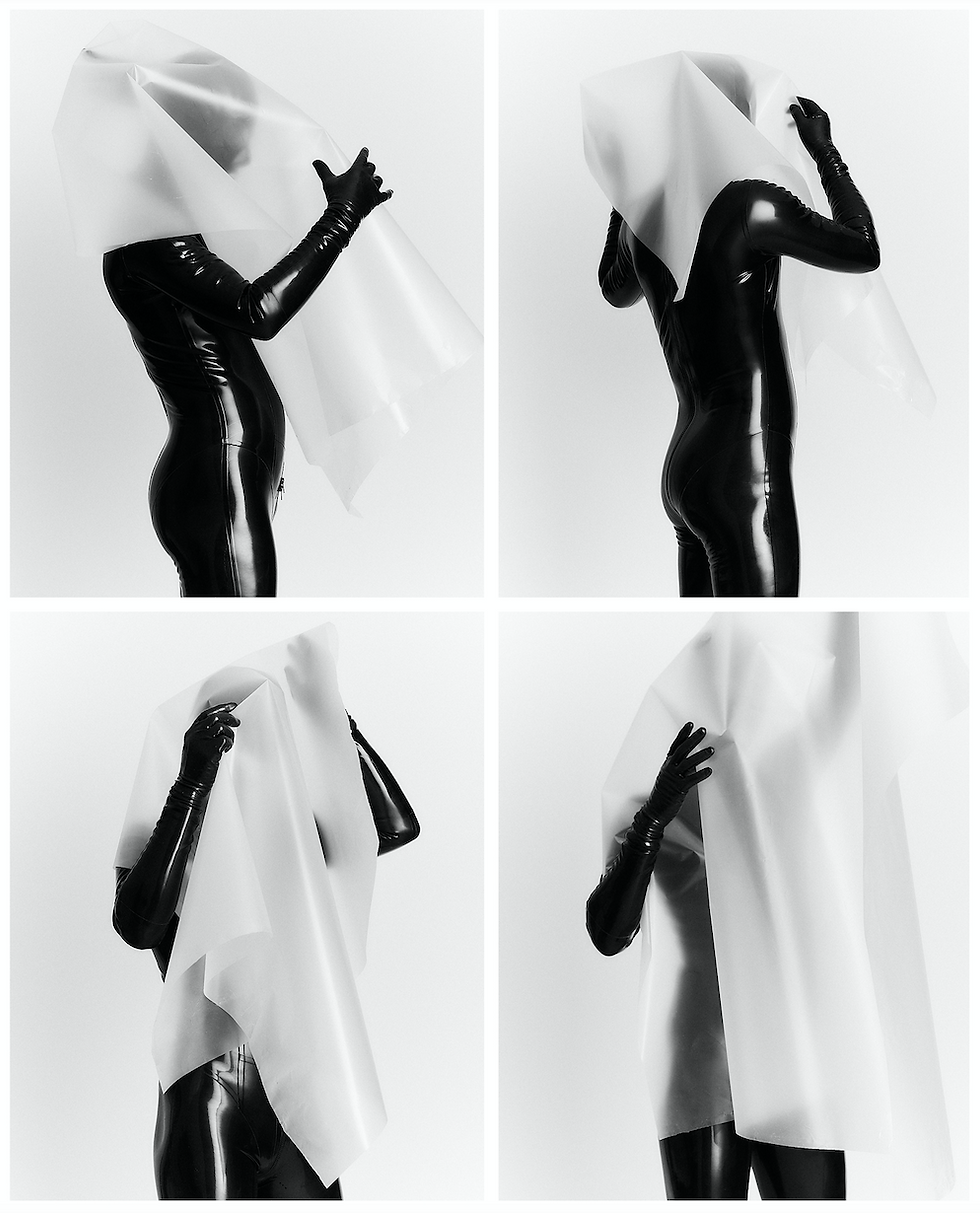
There’s something quietly subversive about Studio Sloe’s work. At first glance, the images are sleek, controlled, almost sculptural — latex glinting like a second skin, the flesh underneath turning into shapes rather than identity. But look longer and the photographs start asking questions back. About desire. About anonymity. About the tension between hiding and revealing.

What begins as fetish imagery quickly unfolds into something more introspective: a visual diary of sexuality, creativity, and the strange intimacy of turning the camera on yourself.

We spoke with Studio Sloe about photographing kink, dissolving gender in imagery, and why sometimes the most powerful part of sexuality is the part that stays hidden.
“Latex provides a surface behind which I can hide and reveal myself at the same time.”
If these photos were the only thing people ever knew about your sexual journey, would you feel fully seen, or are you still hiding the most intense or vulnerable parts?
Yes, there is definitely another level beneath the surface that I deliberately hide from the public. However, this level changes in the process of photographic work. Certain poses or perspectives that were anchored at this level some time ago suddenly come to the surface and want space and to be seen.
For me personally, this is totally exciting and interesting to observe, as it happens unconsciously during a shoot. I must also say that there is an additional filter level, where I question purely rationally whether I really want to entrust this type of intimate photography to these platforms. As a result, there is definitely a visual world that will probably always remain at this hidden level. But perhaps that's not a bad thing, if sexuality is greater than what is represented photographically. It offers a lively form of inspiration and at the same time stimulates by testing personal boundaries.
“But perhaps that's not a bad thing, if sexuality is greater than what is represented photographically.”

You call this project an "oasis." Does that mean the rest of your life feels like a place where your kinks have to be buried or ignored? How does it feel to step into that studio?
I use the term “oasis” because, on the one hand, it feels very good to be able to work on this intimate project in peace and quiet and at a slower pace, and on the other hand, it combines and satisfies the need for sexuality and creativity.

However, this does not arise from a need for either of these things to be lacking in my life, but rather from the symbiosis of these two themes, which I find very enriching. I tend to enjoy the fact that creativity is demanded of me in other ways in my everyday life and that fetishism only accompanies me on a digital level on a daily basis. On the one hand, this leads to a certain urge to get down to the concrete implementation and, at the same time, to react more sensitively to inspiration. As a result, a concrete desire for a specific visual world emerges from a large amount of inspiration.
Does the act of photographing your kinks make them feel more "real" and accepted, or does it just make you want to go deeper into the underground?
Through my photographic work, I learn a lot about my own ideas of sexuality and aesthetics. This happens mainly because there are no fixed rules that I work by. It is a very fluid process that focuses on the visual aspect, but around which many new approaches can emerge. At the same time, photography is a good way to focus on the questions “what do I want to show and what is important to me?” Therefore, I would definitely say that this makes the fetish more noticeable and clearer. The understanding of it becomes more delicate and manifests itself continuously through the photographic work.

On the one hand, this is an important process for me personally, but I also think that through the diverse representation of fetishism, we contribute to breaking down black-and-white thinking and at the same time create a larger platform that helps people to better perceive their own kinks.
“Through diverse representation of fetishism, we contribute to breaking down black-and-white thinking.”
Are you trying to represent men in the kink scene to be seen as more fragile, more powerful, or just more honest? What is the one thing you want to add to the visual world that isn't there yet?
For me, gender and its attributes play no role in shaping my photographs, and I don't consciously think about what statement I want to make as a man in the image or what I represent in that moment. Rather, I ask myself what I want to portray as a surface for contemplation.

For me, the idea is not to stand for something specific as one gender, but rather to try to dissolve boundaries through anonymity and objectification. In this state, however, I find it exciting to play with choosing fragile or dominant body language and pushing the images in a certain direction through editing. It often happens that I re-edit images that were taken a year or two ago. This is sometimes a collage-like process, in the sense that I remove something from the image, add something to it, exchange things, and give it a completely different meaning. Therefore, I cannot say what that one thing might be that I would like to add to the visual world.
However, I would find it beautiful and satisfying if people could see in my pictures that they are about a personal and intimate exploration of my own sexuality and that the pictures evoke something.

How has your view of the kink community changed since you started? Do you feel more connected to it now, or does seeing everyone else’s work make you feel more like an outsider?
Even though my experiences have been limited to the digital space so far, I still feel more connected to it than I did at the beginning. I notice other people who take a similar approach to mine, which confirms my free approach to the subject in the artistic field. I find it exciting that there are so many different ways to portray this topic. Even though stereotypes are often used, I see this more as an incentive to move in the opposite direction with my work. Another important point is the appreciation I receive from other people. This shows me that my pictures generate a certain resonance, which of course makes me very happy.
When you eventually bring other people into your studio, what is the one "secret" you want to pull out of them that traditional photographers usually miss?
I'm not sure if it already leads to synergy when a photographer provides a conceptual basis that is based on mutual trust and is open to new ideas. My visual language is so clear in its aesthetics that I can hardly wait to break it open together with another person.

Even though I want to stay true to my style, I find it incredibly exciting to incorporate other people's perspectives on latex and fetish into my work. The tension between distance and physicality is also completely different with two people than it is alone. That's why I'm very confident that I don't have to actively seek out or bring out something specific in the other person, but that it will develop on its own.
What has been the most difficult thing to admit to yourself about your own desires since you started looking at yourself through a camera?
The idea for the project came about during the corona lockdowns, although initially the focus was not specifically on latex and self-portraits, but rather on sexuality in general, which I wanted to express through still life photography. However, the desire to focus on latex and myself quickly came to the surface. This was probably because it was difficult to express my fetish at that time, and the project served as a kind of outlet. Even though creative work feels like a relief most of the time, the ambivalence between hiding and revealing intimate content can sometimes be a big challenge.

If you had to describe your "kink soul" without using any boring labels or categories, what does it actually look like through your lens?
I perceive it as something that is constantly evolving and branching out in different directions. It is driven primarily by daily visual input and interaction with other people. But it is also something that feels comfortable in restraint, yet wants to be noticed and not suppressed. I think this is also reflected in the predominantly distanced perspective in my work.
“I perceive it as something that is constantly evolving and branching out in different directions.”
Latex is usually associated with explicit fetish imagery. What does it allow you to express that another material wouldn’t?
I like the clarity of the material, how strongly it is associated with sexuality and at the same time offers plenty of room to play with this characteristic. Latex provides a surface behind which I can hide and reveal myself at the same time.

For me, the photographic appeal lies in depicting precisely this smooth, object-like, anonymous and sometimes distant quality, rather than the raw, natural sexuality. I like the interplay between physical and sexual attraction and the perspective of a reserved observer. Therefore, my approach is to remove the personal from the appearance and construct my images in the same way as still life photography.
This project brings together so many different levels of meaning for me, that have a very positive effect on the creative process. The sexual connection, the stimulating effect, both on a visual and physical level. At the same time, the desire and urge to explore new but familiar paths artistically. It is a deeply fulfilling process that fuels itself over and over again.
By: Amanda Sandström


