


How to Make Sex Toys: A Guide
- Amanda Sandström Beijer
- 2 days ago
- 5 min read
3 AM has a specific texture: dry mouth, dim screen light, and the sudden conviction that your body is a design problem you could solve with what’s already in your drawers. Not “horny” in the sentimental sense. Horny in the way a bored engineer gets horny for a prototype.
The market does not need your help. Sex toys are already high-tech, art-directed, and aggressively competent: app-controlled, air-pulsing, heating, rotating, ergonomic, and sterile enough to survive a corporate audit. Still, the thought arrives—persistent, private, slightly insulting: but what could I build? Not to compete with the shops. To make it personal. To see what happens when your own curiosity runs the lab.

This is the intellectual core of how to make sex toys: horny engineering as self-knowledge. You are not shopping for sensation; you are isolating variables. Texture. Pressure. Vibration. Temperature. Control. The “I wonder what I could create” itch is not a budget issue. It’s an authorship issue.
A warning, delivered in the tone of someone who has made enough mistakes to dislike improvisation: bodies are not forgiving materials. DIY sex toys can be elegant, safe, and genuinely revelatory. They can also become a humiliating emergency room anecdote that gets told at a nurse’s birthday dinner. Keep the curiosity. Add standards.
The Boring But Absolutely Necessary Safety Talk
Non-Porous Is Non-Negotiable.
Your DIY creation needs to be made from materials that don’t absorb fluids, bacteria, or your personal mythology. Silicone, glass (specifically borosilicate), stainless steel, and certain hard plastics are functional. Porous materials like wood, rope, and fabric become bacteria hotels after one use. If you insist on something questionable, use a condom as a barrier and accept that this is risk management, not romance.
Sharp Edges Are A Hard No.
Run your hands over anything before it goes anywhere near your body. If it feels rough, sand it down or wrap it. A scratch on furniture is a nuisance; a scratch inside you is an event with paperwork.
If It Doesn’t Have A Flared Base, It’s Not Going Internally.
Especially for anal play. Bodies have impressive suction abilities, and you do not want to test them for sport. Flared bases, handles, strings—anything that prevents full insertion is mandatory.
Lubrication Is Not Optional. Make it slippery. Water-based lube works with everything. Silicone lube is excellent but can degrade certain materials. Coconut oil feels indulgent but will destroy latex condoms. Adult experiments still require basic compatibility checks.
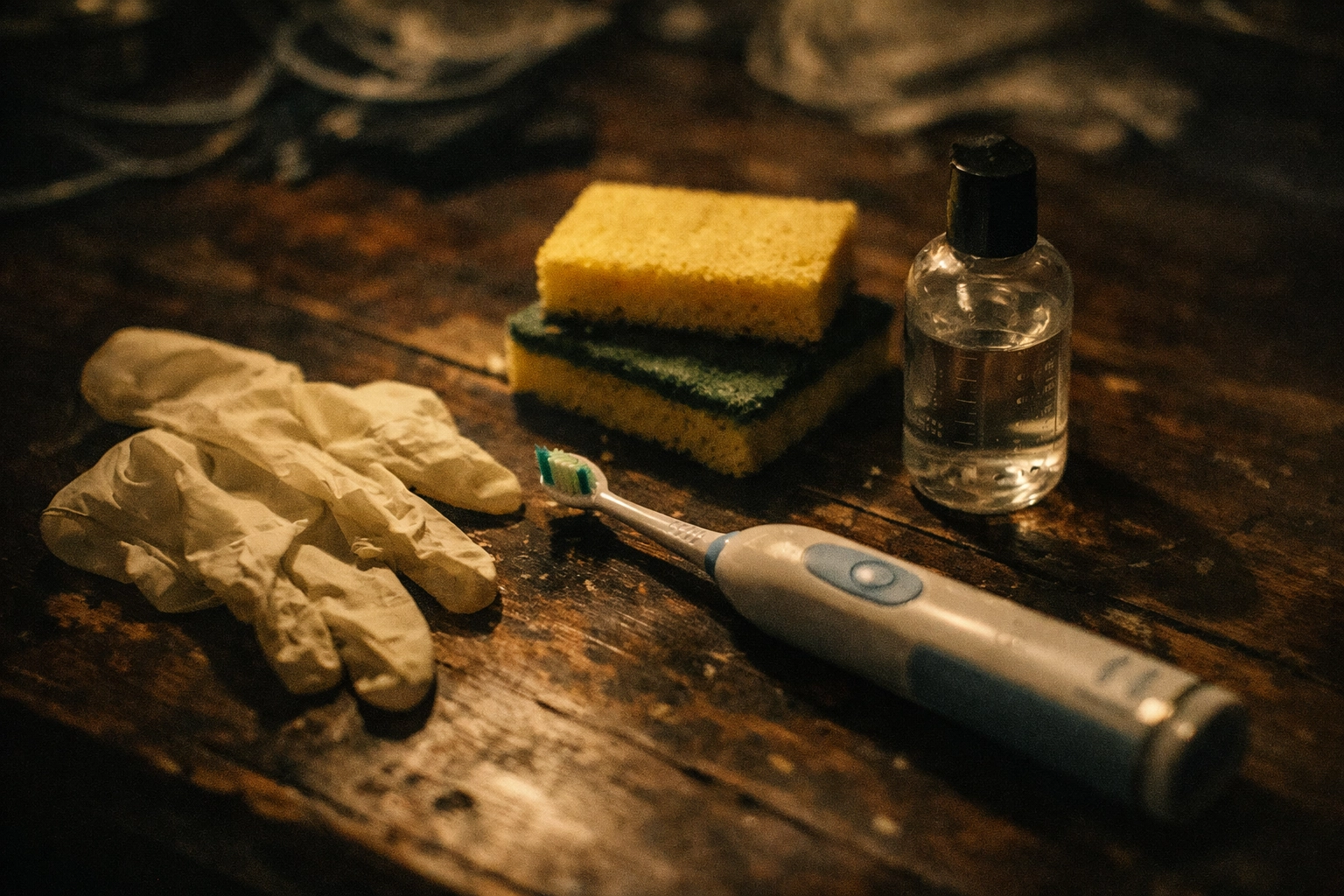
What Actually Works: The Safe DIY Arsenal
The Electric Toothbrush Hack
Electric toothbrushes were not designed for genitals; they were designed for the anxious mouth-breathers of modern life. They vibrate consistently, live in your bathroom, and function as a low-stakes vibration source. Use the handle end, cover it with a condom, add lube, and keep the bristles out of this story.
Pro Tip: Buy a dedicated one. “Multi-use hygiene” sounds efficient until you picture it clearly.
The Glove-and-Sponge Stroker
A functional penetrative toy, built with household materials and minimal fantasy. Take two kitchen sponges, place a latex or nitrile glove between them, insert the whole thing into a cup or plastic bottle with the top cut off, fold the glove opening over the edge, secure with rubber bands, then add lube inside the glove.
The logic is simple: sponges create adjustable pressure, the glove provides a smooth, cleanable barrier, and the container keeps the structure stable. It is crude engineering. It works.
Smooth Household Objects (With Extreme Caution)
Certain objects can work only if they meet the same standards a decent sex toy meets: non-porous, no sharp edges, a flared base or a reliable way to retrieve it, and a condom barrier.
Objects people use without immediate consequences include:
The handle end of makeup brushes (silicone or hard plastic only)
Smooth rolling pins (condom, external use preferred; vaginal use only with constant grip and zero improvisation)
Certain glass bottles (borosilicate only, thick glass, no seams or chips)
This is the zone where horny engineering becomes sloppy. If you feel even slightly unsure, stop. The point is self-knowledge, not self-harm.

Silk Scarves and Soft Restraints
Restraints are one of the safer DIY categories. Silk scarves, soft rope (around limbs only), neckties, and yoga straps can create controlled restriction without specialized gear. The rule is boring and absolute: easy release. Complex knots are for sailors and people who enjoy administrative stress.
If you want to explore power dynamics beyond “tie my wrists and hope for the best,” a kink sheet helps you map preference, boundaries, and consent language before you start experimenting.
Ice, Warmth, and Temperature Play
Freeze water in a condom for an improvised ice dildo (flared base rule still applies; tie a knot at the end). Warm a metal spoon under hot water, then run it over skin. Not technically “toys,” more like sensory instruments. Cheap, precise, and surprisingly intense.
Can You Actually Make a Vibrator?
Short answer: rarely, and not safely without relevant skills. Motors meant for consumer electronics are not designed for moisture, heat, and sustained pressure in intimate contact. The compromise is obvious: use devices already engineered for continuous vibration and indirect body contact. Massagers marketed for “back pain” occupy this category with suspicious frequency.
DIY-ing a motorized sex toy involves electrical components, battery safety, waterproofing, and multiple ways to electrocute your genitals. If that sentence activates you, fine; you still need engineering competence, not confidence.
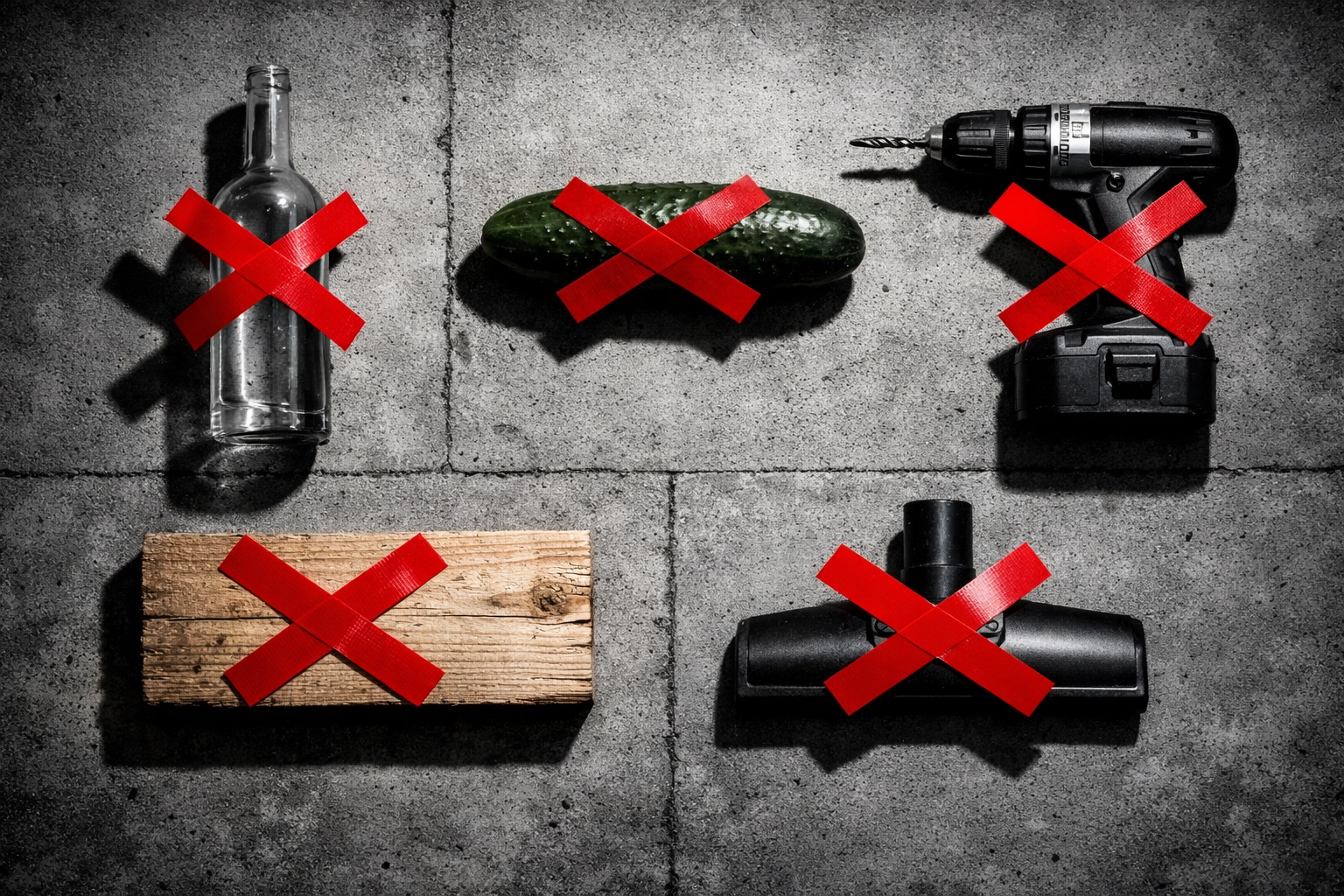
Don’t Even Think About It: The Danger Zone
Some materials are so structurally wrong for internal use they deserve public shaming:
Anything Glass That Isn’t Borosilicate.
Regular glass can shatter with body heat, pressure, and bad luck. Borosilicate (like Pyrex) is engineered for thermal stress. Random glass bottles are not.
Porous Wood.
Wood can be body-safe only if properly sealed with a non-toxic finish and maintained like a tool, not a kitchen utensil. Most household wood is untreated, porous, and prone to splintering. Keep it out of orifices.
Cucumbers, Bananas, And Other Produce.
Yes, they are shaped conveniently. No, they are not clean or reliable. They can break, they harbor bacteria, and “natural” is not a medical category. If you insist, a condom reduces risk; it does not make this intelligent.
Anything With A Motor Not Designed For The Body.
Drills, sanders, power tools. If you need a trigger and a safety briefing, it is not a sex toy. Tutorials exist; emergency rooms exist for the same reason.
Vacuum Cleaners.
The suction is not calibrated for genitals. You will injure yourself.
How Do You Clean Homemade Sex Toys?
If it’s wrapped in a condom, remove and discard the condom, then clean the base object with warm water and soap. If it’s non-porous (glass or steel), wash thoroughly with antibacterial soap, rinse completely, and air dry. If it’s porous and used without a barrier, treat it as disposable. Bacteria do not respect your sentimental attachment to a “modified” object.
Is DIY Actually Worth It?
DIY sex toys are rarely “better” than well-made commercial toys. They are better at something else: producing insight. The act of prototyping forces specificity—what shape, what pressure, what tempo, what level of control. It turns arousal into observation, then into design.
There is also a psychological advantage: authorship. Making a tool changes how you relate to it. If you are exploring kink dynamics such as impact play, building something together can be part of the charge. A paddle you made carries different meaning than one you ordered in a rush.
DIY is a rite of passage because it teaches you how to think: about materials, bodies, risk, consent, and your own patterns. The experiment is the point. The orgasm is data.
Keep it clean. Keep it controlled. Keep it a little strange.