


Sex Drive Comparison: Why Men and Women are Not on the Same Page
Updated: Feb 15
A thing nobody tells you when you move in together and realise you're not in sync, sexually: your libidos aren’t “mismatched.” Your nervous systems are. And cohabitation is basically a full-time stress test where the smallest daily frictions (tone, chores, calendars, his mom visiting) can quietly murder desire without leaving fingerprints.

Welcome to the Desire Divide: one person can want sex as a quick stress reliever, while the other needs to stress reduce first or their body is like, “Hard pass, we’re in threat-management mode.”
He feels stressed and reaches for sex to regulate.
She feels stressed and can’t access sex until she’s regulated.
Let’s talk about what the science actually says—and how to stop treating “why don’t you want sex?” like a mystery and start treating it like household logistics with consequences.

The Gas Pedal vs. The Ignition Switch
Most sex education stops at "everyone's different!" which is true but useless. The more accurate model? Spontaneous desire versus responsive desire, and for most people, this breaks along pretty predictable lines.
Spontaneous desire is the "gas pedal" model. It shows up uninvited. You're sitting in a budget meeting, or folding laundry, or watching the news, and suddenly your brain goes: Sex. Now. No context needed. No foreplay required. Just an internal engine that revs on its own schedule. This is how desire works for a lot of men (though not all, more on that later).
Responsive desire is the "ignition switch" model. It doesn't start on its own. It needs a spark, a touch, a compliment, the right lighting, a partner who's done the dishes without being asked. The arousal comes first, and then the desire follows. It's not that the engine doesn't work; it just needs someone to turn the key. This is how desire works for a lot of women (and, again, plenty of men too).
The problem? When you're on the gas pedal, you assume everyone else is too. When you're the ignition switch, you assume your partner should know you need to be warmed up first. And nobody talks about it until someone's feelings are hurt, and the sex has stopped entirely.
Spontaneous Desire (Common in Men):
Internal Trigger (hormones, random thoughts, visual cues)→ Desire ("I want sex")→ Arousal (physical response)→ Sex
Responsive Desire (Common in Women):
External Trigger (touch, atmosphere, emotional safety)→ Arousal (physical response)→ Desire ("Oh, okay, I'm into this now")→ Sex
The Hormonal Soup We're All Swimming In
If we get biochemical for a second; testosterone is the Don Draper of sex hormones, constant, reliable, always ready for a meeting. Men produce it in steady, predictable waves. It hums along at relatively stable levels throughout the day, every day, keeping that spontaneous desire dialed to "medium-high" most of the time.
According to research published in Testosterone and Sexual Desire in Men and Women, testosterone is a major driver of libido in both sexes, but men have 10 to 20 times more of it circulating at any given moment. That's not an excuse; it's just biology.
Women, on the other hand, are running a hormonal roller coaster. Estrogen and progesterone fluctuate throughout the month, creating peaks and valleys of desire that can feel random if you're not tracking them. Mid-cycle, right around ovulation, estrogen spikes, and suddenly you're the horniest version of yourself. It's not magic; it's your body doing a biological heist to get you pregnant. Studies on The Role of Estrogen in Female Sexual Function show that estrogen doesn't just affect arousal, it impacts lubrication, sensitivity, and how your brain processes sexual cues.
Then progesterone kicks in during the luteal phase (post-ovulation), and desire often drops. Add in stress, birth control, or postpartum hormones, and you've got a system that's constantly recalibrating. It's exhausting, and it's not "all in your head."
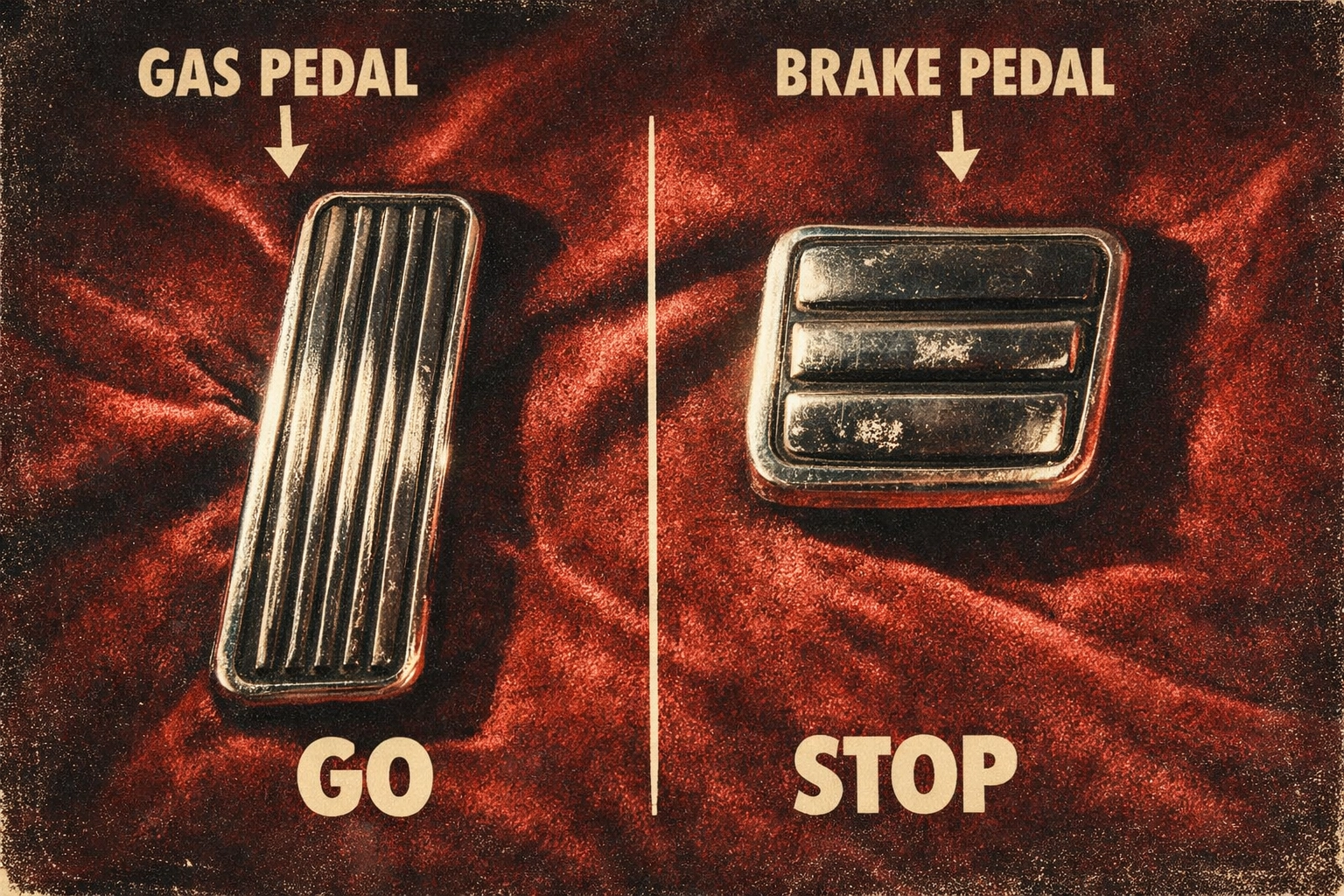
The Dual Control Model: Gas and Brakes
Here's where it gets really useful. Psychologists Emily Nagoski and Erick Janssen developed something called the Dual Control Model, which you can read about in depth here. The idea is simple: your sexual response isn't just about turning on, it's also about turning off the brakes.
The gas pedal (the Sexual Excitation System) is everything that revs you up, touch, novelty, dopamine, attraction, dirty talk, a partner who smells good and looks at you like you're the only person in the room.
The brakes (the Sexual Inhibition System) are everything that shuts you down, stress, exhaustion, body insecurity, fear of pregnancy, a sink full of dishes, kids who might wake up, the mental to-do list that never ends, and the creeping dread that you're supposed to perform instead of enjoy.
For most men, the brakes are lighter. Stress might slow them down, but it rarely stops the engine. For most women, the brakes are on by default, and the entire sexual experience depends on how much you can lift them before trying to press the gas.
That's why "just try to relax" is such garbage advice. You can't "just relax" when your nervous system is wired to scan for threats, and half of those threats are invisible to your partner (Will I come? Will this take too long? Did I shave? Am I supposed to look sexy right now?).
Desire isn’t “mysterious.” It’s competing with 37 browser tabs and one of them is labeled “buy birthday gift for nephew.”
Nervous System Regulation (Why Threat Mode and Arousal Mode Don’t Coexist)
If you want a practical explanation for “why she’s not in the mood,” skip the personality theories and look at the wiring: you can’t be in threat mode and arousal mode at the same time. That’s not “women are sensitive.” That’s mammal software.
When the body detects conflict cues—raised voices, contempt, unpredictability, that specific weaponized sigh—it leans into sympathetic activation (fight/flight/freeze). In plain terms: cortisol/adrenaline go up, and the body prioritizes scanning + self-protection. Arousal runs on a different chemistry set: more dopamine for motivation/attention, more oxytocin for bonding/safety signals, more parasympathetic “rest-and-digest” capacity.
There’s evidence that high sympathetic nervous system activation can inhibit women’s physiological sexual arousal (it’s not linear; there’s a “too much activation = shutdown” curve), as shown in Evidence for a curvilinear relationship between sympathetic nervous system activation and women’s physiological sexual arousal (PubMed Central).
Also relevant: the Dual Control Model isn’t just theory. Newer work still supports that sexual inhibition can dampen the brain’s processing of erotic cues—aka the stimuli can be there, but the brain is busy running “risk assessment” instead of “ooh, interesting” (Interplay between sexual excitation and inhibition… in women, Frontiers in Behavioral Neuroscience, also on PMC).
So when someone says, “Okay, sorry I snapped. Can we reset?” and the other person still feels distant an hour later—this isn’t a moral failing. It’s physiology. Regulation takes time. Trust repair takes consistency. A quick apology can be sincere and still not be enough to flip the nervous system back into “safe + open” that day.
Q&A
Why does yelling (or a harsh tone) kill desire in a relationship? Because conflict cues can push the body into threat-mode physiology. When sympathetic activation is high, sexual arousal is often inhibited—your system is allocating resources to safety, not pleasure.
How long does it take to feel regulated again after a fight? It depends on intensity, history, and repair quality. Regulation is faster when repair is specific (accountability + changed pattern), slower when the same conflict repeats and the body learns to stay braced.
Cognitive Bandwidth
Now let’s talk about the least sexy substance ever discovered: cognitive bandwidth.
If your brain is running “household OS” background tasks—logistics, social calendars, domestic management, remembering that your parents are visiting, tracking supplies, anticipating mess—there’s less processing power left for erotic attention. Not because anyone is “organized” or “uptight,” but because attention is finite.
And yes, this often lands unevenly in straight cohabitation: one person becomes the default operator for the shared life. That unequal distribution of cognitive labor functions like a sexual brake. Desire isn’t “mysterious.” It’s competing with 37 browser tabs and one of them is labeled “buy birthday gift for nephew.”
This is where the Dual Control Model gets painfully domestic: more stress + more cognitive load → more inhibition. It’s not a character flaw. It’s systems design.
And if you’re thinking, “But sex would help them relax,” congrats: you’ve just described the next section.
Foreplay is what you do at 3pm that makes the household feel regulated at 11pm. This isn’t romance. It’s environment.
Release vs. Repair
A lot of men (not all, don’t email me) use sex like a pressure valve. Stress happens → horny happens → orgasm happens → nervous system quiets down. Quick release. Fast relief. Very efficient. Like an emotional vape.
A lot of women (again: general pattern, not a law) need the opposite sequence: stress goes down first → safety returns → body opens → desire shows up.
This is why you get the classic cohabitation deadlock:
He feels stressed and reaches for sex to regulate.
She feels stressed and can’t access sex until she’s regulated.
Both are trying to feel better. They’re just using different operating systems.
Foreplay Starts in the Google Calendar (aka Shared Stewardship)
If you want “more sex,” stop treating foreplay like a 12-minute pre-roll. Foreplay is what you do at 3pm that makes the household feel regulated at 11pm. This isn’t romance. It’s environment.
The most useful framing isn’t “help her.” It’s shared stewardship: optimizing the relationship like a system. Any high performer understands this part: to get the best output, you remove friction points. You reduce cognitive load. You stabilize the emotional climate. You stop leaking energy through constant micro-conflict and unpaid labor.
Here are some extremely unsexy, extremely effective moves:
Put the nephew’s birthday in your own calendar. Buy the gift. Wrap it. Done. (No delegation meeting required.)
Change the sheets before family visits (or any visit). Don’t ask what thread count. Just make the bed like an adult who lives there.
Own one whole logistics lane. Groceries + meal planning, bills, laundry, cleaning. Not “helping.” Stewardship.
Don’t outsource management. If one person has to assign tasks, they’re still doing the cognitive labor—just with extra steps.
Treat repair like repair. If conflict happened, regulate first. Then reconnect. Sex isn’t a refund.
And yes, this ties back to kink too: if you’re playing with power, you still need regulation, consent clarity, and aftercare. If you want a structure for talking about wants and limits without turning it into a courtroom drama, use Playful’s Yes-No-Maybe Manifesto.

The Diagram: How Desire Actually Works
Let's break it down visually:
Spontaneous Desire (Common in Men):
Internal Trigger (hormones, random thoughts, visual cues) → Desire ("I want sex") → Arousal (physical response) → Sex
Responsive Desire (Common in Women):
External Trigger (touch, atmosphere, emotional safety) → Arousal (physical response) → Desire ("Oh, okay, I'm into this now") → Sex
Notice the difference? Spontaneous desire starts with wanting. Responsive desire ends with wanting. Same destination. Completely different route. And if you're trying to seduce someone on the responsive model by asking, "Do you want to have sex?", you've already lost. The answer will almost always be "not really," because the desire hasn't been activated yet.
This is why foreplay isn't optional. It's not the appetizer, it's the ignition. However, it's neither three kisses on the neck after having left your partner with taking care of all household chores and being your psychologist for the past three hours while you forget holding space for their well being.

Internal Trigger (hormones, random thoughts, visual cues)→ Desire ("I want sex")→ Arousal (physical response)→ Sex
Responsive Desire (Common in Women):
External Trigger (touch, atmosphere, emotional safety)→ Arousal (physical response)→ Desire ("Oh, okay, I'm into this now")→ Sex
The Caveats (Because Nothing Is Ever Simple)
Let's be extremely clear: these are generalizations, not laws. Plenty of women have high spontaneous desire. Plenty of men are responsive and need emotional safety, the right context, and a partner who doesn't just assume they're "always ready." Libido is a spectrum, not a binary, and it shifts with age, stress, health, medication, and life circumstances.
Some women want sex more than their male partners. Some men need to be seduced. Some people are both, depending on the week. And some people, hello, asexual and gray-ace communities, don't experience sexual attraction in these frameworks at all, and that's just as valid.
If you're reading this and thinking, "Wait, I'm a woman and I have spontaneous desire," or "I'm a guy and I need way more warm-up than this describes", congratulations, you're human. The model is a tool, not a diagnosis.
So What Do You Actually Do With This Information?
First, talk about it. Not in bed, not when someone's already frustrated, but when you’re both calm and not actively trying to “win.” Use the Yes-No-Maybe Manifesto if you need structure.
Second, stop expecting your partner to "just be in the mood." If they're responsive, create the conditions for arousal before you expect desire to show up.
That means:
reducing the brakes (lower the conflict, lower the chaos, lower the cognitive load)
prioritizing nervous system regulation (tone, predictability, repair, and not treating conflict like cardio)
and then pressing the gas (touch, flirting, anticipation—without turning it into a transaction)
Third, if you're the responsive one, communicate what you need in plain language. Your partner isn't psychic, and "I don't know, I'm just not in the mood" doesn't give them anything to work with. Be specific. "I need 20 minutes of making out before I'm ready" is actionable. "You never initiate right" is not.
Q&A (practical cohabitation edition)
Why does my boyfriend/husband want sex right after we argue? For some people, sex functions like quick regulation (release): stress spikes, orgasm drops the pressure. For others, conflict cues push the nervous system into threat-mode, and arousal won’t come online until there’s repair and regulation. Same relationship, different physiology.
How can I increase desire in a long-term relationship without “spicing it up”? Start with the boring stuff: reduce stress, share the mental load, and repair conflict patterns. Novelty helps, sure—but safety and support are the base layer. “Spice” on top of resentment tastes like cardboard.
Is it normal to not want sex when I’m overwhelmed with chores and planning? Yes. Overwhelm is a brake. If your brain is in management mode, shifting into a sexual state can be hard—not because you don’t love your partner, but because your body is prioritizing survival and problem-solving.
And if you're stuck in a pattern where nobody's having sex because nobody's initiating, or because one person feels rejected every time: consider that you might not be speaking the same language. Understanding the Desire Divide won't magically fix everything, but it'll at least get you both reading from the same script.
Because the goal isn't to want sex at the exact same time, in the exact same way. The goal is to understand how each of you gets there—and to stop sabotaging the conditions that make desire possible.
Or, you know, keep treating her like a vending machine where you insert “apology” and expect sex to fall out. Your call.


