


Techno-Somatic Healing: Why 48 Hours on a Dark Dancefloor is Cheaper (and Faster) Than Therapy
Updated: Feb 26
I'm not suggesting you should cancel your therapist. But if you've spent six months staring at a tasteful beige wall, discussing your childhood while your practitioner nods sympathetically and charges €120 per hour, and you still feel like you're carrying a backpack full of broken glass, maybe it's time we talk about the dancefloor.
Sometimes your body knows things your brain refuses to acknowledge. And sometimes, the fastest route to processing that shit isn't through another carefully worded revelation about your attachment style. Sometimes it's through 48 hours in a pitch-black room where the bass is so heavy it reorganizes your internal organs, and you forget you ever had a name, let alone a LinkedIn profile.

Welcome to techno-somatic healing. It's messier than mindfulness, cheaper than psychoanalysis, and it might just vibrate the trauma out of your nervous system before your next therapy invoice arrives.
Your Body Keeps the Score (And the Beat)
The concept isn't exactly new. Bessel van der Kolk spent decades proving that trauma lives in the body, not just the mind. Somatic therapy, the legitimate, clinical kind, uses physical sensations, breathwork, and movement to help people process experiences that talk therapy can't quite reach. It's about accessing the parts of you that went offline when language failed.
Now, nobody's claiming that Berghain is an accredited treatment center. But the mechanism?
Surprisingly similar. When you're locked into a 140 BPM rhythm for hours, your body enters what researchers call a flow state, that egoless zone where time dissolves and your prefrontal cortex (the part of your brain that won't shut up about your to-do list) finally takes a seat. It’s also why the sensory intensity can feel… addictive, in the most respectful, “please don’t take my strobe lights away” way. If you want the neurobiology of why your brain craves intense stimuli (and yes, this overlaps with kink brains too), here’s the rabbit hole: Science of Fetish: Why Your Brain Craves It.
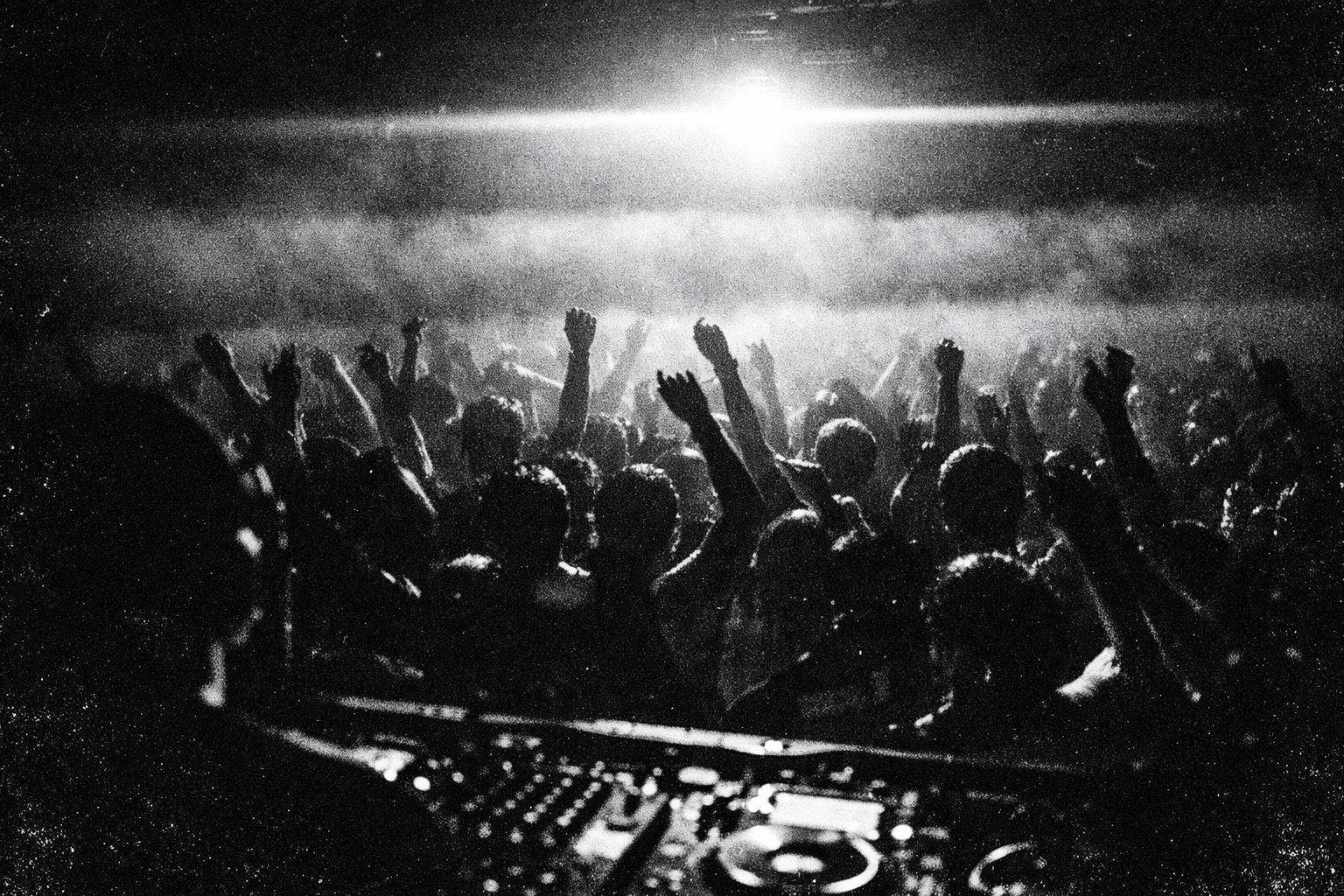
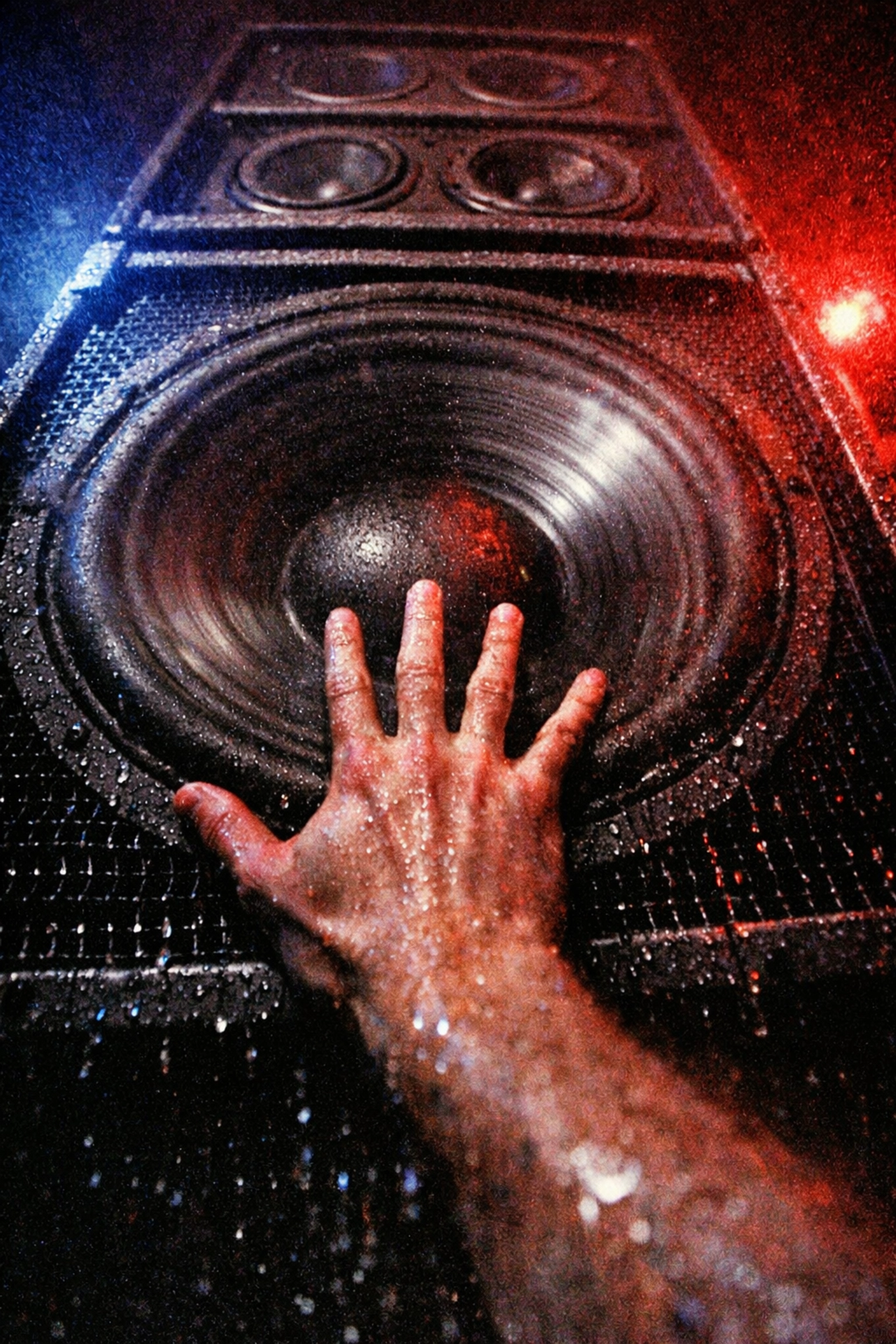
The bass frequencies, particularly those sub-bass rumbles that you don't just hear but feel, create a full-body vibration that mimics the kind of release somatic practitioners spend sessions trying to facilitate. Your diaphragm loosens. Your psoas muscle (where we store our fight-or-flight responses) unclenches. And suddenly, that thing you've been white-knuckling for months just... moves through you.
140 BPM and Your Nervous System: A Love Story
Let's get nerdy for a second. Your autonomic nervous system has two modes: sympathetic (fight, flight, freeze, frantically respond to Slack messages at 11 PM) and parasympathetic (rest, digest, remember what it feels like to be a mammal). Most of us are stuck in sympathetic overdrive, which is why we're all so fucking tired.
Rhythmic movement, especially sustained, repetitive movement, has been shown to regulate the nervous system. Studies on bilateral stimulation (think EMDR therapy) suggest that engaging both sides of the body in rhythm can help process traumatic memories. Dancing does this automatically. Left foot, right foot. Left arm, right arm. Your body creating its own bilateral magic while your conscious mind is too busy surrendering to the kick drum to interfere.
The tempo matters too. Around 120-140 BPM sits right in that sweet spot that feels urgent without being anxious, driving without being aggressive. It's fast enough to keep you moving, slow enough to let you sink into it. Your heart rate syncs. Your breath deepens. And somewhere around hour six, when you've sweated through every layer and your legs have stopped being separate entities you control and started being part of the sound system itself, something shifts. That whole “dancefloor high” isn’t just poetic nonsense either; it has an emotional comedown component, too — the part where your serotonin swagger turns into a quieter, weirdly tender aftertaste. If you’ve ever wondered why you can feel invincible at 4 AM and vaguely hollow at brunch, say hi to The “Oxytocin Hangover”: The Neuroscience of Sub-Drop & Dom-Drop (same mechanics, different costume: harness vs. hoodie).
Ego Death vs. Talking About Your Mother (Again)
Traditional talk therapy has its place. Truly. But there's a limit to what you can think your way through. At some point, insight becomes a loop. You understand why you're anxious, where your patterns come from, how your childhood shaped your attachment style, and yet you're still anxious. Still stuck. Still performing the same old script.
The dancefloor offers a different option: temporary ego annihilation. Call it ego death, call it surrender, call it the sweet relief of not having to be a coherent brand for once. If you’ve ever caught yourself thinking “Why does giving up control feel this good?” you’re not broken — you’re just human, and there’s an entire brainy explanation for why smart, strong people love to submit (to a person, to a beat, to the collective grind of a room): The Psychology of Power Exchange.
When you're in a properly dark club, and I mean dark, the kind where you can't see your own hand in front of your face, you lose your reference points. No mirrors. No phones (if you're in the right spots). No way to perform "you." The person who has a job title and a carefully curated Instagram presence simply doesn't exist in that space. There's just the sound, the movement, and a few hundred other people who've also agreed to dissolve into the collective body.
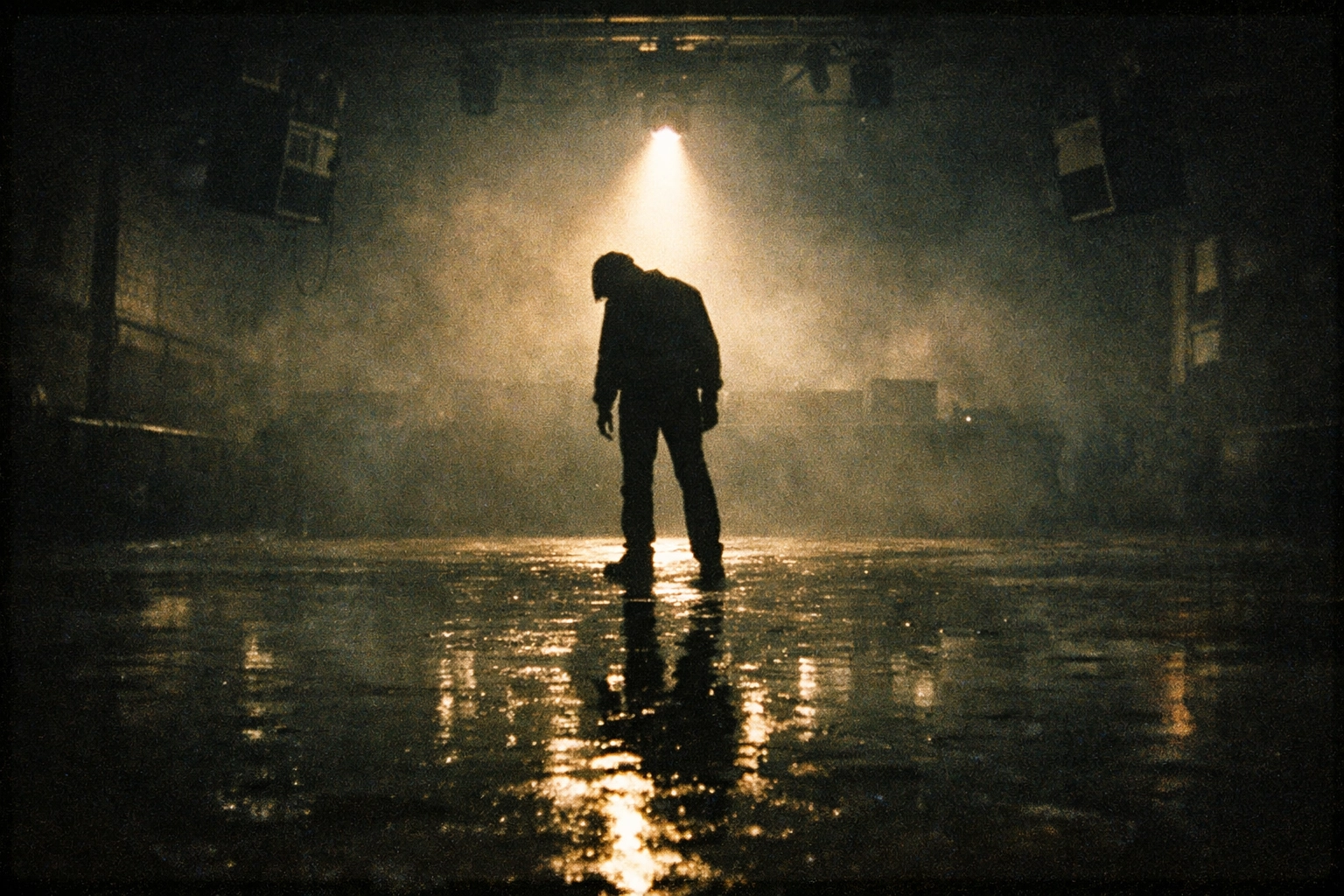
This isn't spiritual bypassing. It's not "good vibes only" positivity culture. It's the opposite, it's permission to be nothing. To let everything you're holding collapse for a bit. And weirdly, that's often more healing than another session trying to construct a coherent narrative about why you are the way you are.
As writer and somatic practitioner Resmaa Menakem points out, sometimes the body needs to complete a stress cycle before the mind can make sense of it. The dancefloor gives you that completion. The shaking, the sweating, the full-body exhaustion, it's the physiological equivalent of finally finishing the sentence your nervous system has been trying to say for years.
The Black Box: Where Vulnerability Meets Volume
There's something uniquely potent about the underground club environment that doesn't translate to, say, a yoga studio or even a conventional concert. Maybe it's the darkness. Maybe it's the door policy that keeps out the tourists and the stag parties. Maybe it's the fact that everyone in the room has made a deliberate choice to show up and surrender to something bigger than themselves. If you want a real-world case study in the “black box” as a full-body, chaos-friendly container, start with Sisyphos Berlin: A Hedonist’s Guide to the City’s Most Chaotic Club — the place where your sense of time gets mugged in broad daylight and you thank it afterwards.
But there's a safety in that space, a weird, gritty, sweat-soaked safety, that you don't find in many places. You can cry on a dancefloor and nobody will ask if you're okay. You can move in ways that would look ridiculous in daylight and nobody's watching anyway. You can be completely vulnerable and completely invisible at the same time.
Berlin's underground club culture has always understood this. The emphasis on anonymity, on door policies that prioritize vibe over appearance, on spaces designed to dissolve social hierarchies, it's not accidental. These rooms were built for people who needed somewhere to be something other than what the outside world demanded. And while Berlin loves to act like it invented hedonism, the wider electronic ecosystem is mutating globally in real time — pop monoculture, regional scenes, internet genres eating each other alive. For a sharp take on that bigger evolution (and what it means for techno’s future identity crisis), read K-Pop’s World Takeover: What It Means for Techno, Breakbeats, and Electronic Music.
It's the same principle that makes kink spaces so effective for processing power and shame: clear boundaries, radical consent, and permission to explore parts of yourself that polite society would rather you keep locked away.
Why It's Not Actually Therapy (And Why That's Fine)
If you're dealing with serious mental health issues, clinical depression, PTSD, suicidal ideation, you need professional help. A dark room with good speakers is not a replacement for medication, crisis intervention, or trauma-informed therapy.
But here's what the dancefloor can do that your therapist can't: it can give you a full-body experience of release without requiring you to explain yourself. It can provide community without demanding vulnerability. It can offer a reset without needing you to have any insights about it.
Research on embodied cognition suggests that our bodies inform our emotional states just as much as our thoughts do. Change your physiology, move differently, breathe differently, take up space differently, and your emotional landscape shifts too. The dancefloor is just the most efficient delivery system for that shift.
Plus, let's talk economics. A weekend at a proper club will run you maybe €30-50 in entry fees, plus whatever overpriced water you can stomach. A weekend of therapy sessions? Try €500+, assuming your therapist even works weekends. I'm not saying one is better than the other. I'm saying that for a lot of people trying to maintain their sanity on limited resources, the dancefloor is the more accessible option.
The Monday Morning Reality Check
Look, if you're expecting to walk out of KitKat at 10 AM Monday morning as a fully actualized, healed human being with zero unresolved trauma, I have some disappointing news. You're going to be exhausted, possibly still vibrating at 140 BPM internally, and absolutely useless at your desk job.
But something will have shifted. Maybe just a little. Maybe just enough that the thing that was taking up all your mental bandwidth last week feels slightly less urgent. Maybe you remembered what it feels like to be in your body instead of just operating it from a distance like a shitty remote control.
And maybe, just maybe, you'll realize that healing doesn't always look like having everything figured out. Sometimes it looks like getting lost in the dark, letting the music move through you, and trusting that your body knows how to process what your brain keeps trying to solve.
So no, 48 hours on a dancefloor isn't therapy. But it might be the thing that makes therapy actually work. Or it might be the thing that buys you another month before you need therapy. Or it might just be the reminder that you're a physical creature, not just a anxious brain in a meat suit, and sometimes the fastest way through is to move.
Just remember to hydrate. Your somatic healing experience will be significantly less profound if you pass out from dehydration.


